
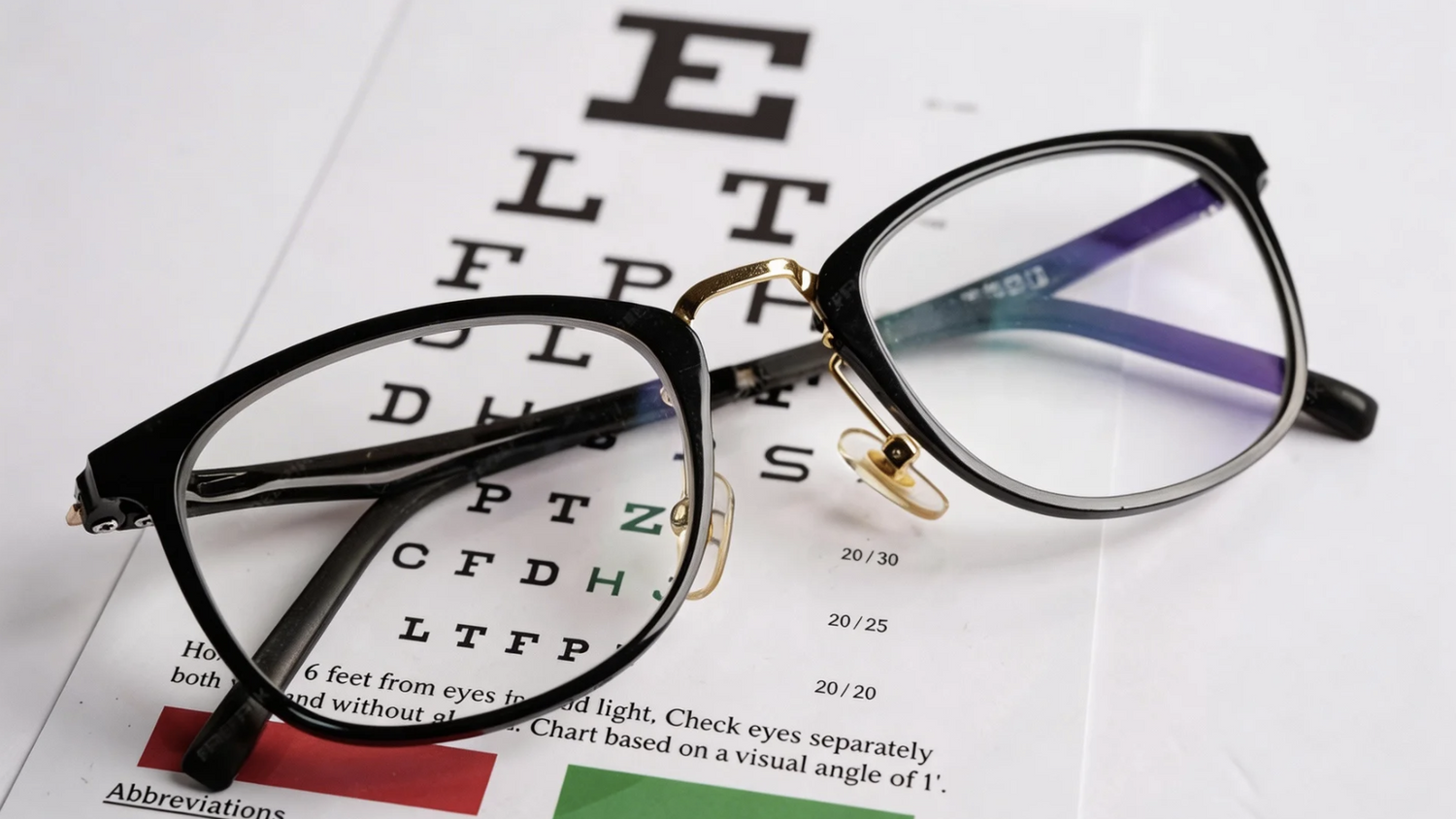
How to Read Your Eye Prescription: A Clear Vision Guide
Understanding your eye prescription is the first step toward perfect visual clarity. It serves as a detailed map of your vision, indicating whether you are nearsighted, farsighted, or have astigmatism.
When ordering glasses online, having the knowledge to read your prescription allows you to navigate the process with ease and accuracy. You likely received a prescription slip from your eye doctor, similar to the one shown in the image below. While the formatting may vary from clinic to clinic, the core information remains universal.

Sample Prescription Layout: Typical rows and columns you will see on your RX.
1. The Foundation: What Do OD and OS Mean?
The most common abbreviations you will encounter are OD and OS. These are derived from Latin and are the traditional way doctors identify which eye they are referring to.
- OD (Oculus Dexter): This refers to your Right Eye.
- OS (Oculus Sinister): This refers to your Left Eye.
- OU (Oculus Uterque): This refers to Both Eyes. While less common on a standard prescription, it is a professional term used when the measurement is identical for both sides.
Velora Tip: You might notice that our ordering page always lists the Right Eye (OD) first, followed by the Left Eye (OS). This follows the international standard used by optometrists. By keeping this consistent order, we minimize the risk of "swapping" your values—ensuring your custom lenses are crafted exactly as the doctor intended.
2. Breaking Down the Numbers: SPH, CYL, AXIS, and PD
The numbers on your prescription represent Diopters, the unit used to measure the power of the lens. Let’s break down the "Big Four" measurements:
SPH (Sphere)
The Sphere value indicates the primary lens power required to correct your vision.
- The Minus Sign (-): If your number has a minus sign (e.g., -2.50), you are Nearsighted (Myopia), meaning you have trouble seeing things far away.
- The Plus Sign (+): If your number has a plus sign (e.g., +1.25), you are Farsighted (Hyperopia), meaning you struggle with close-up tasks.
CYL (Cylinder) & AXIS
These two values always go hand-in-hand and refer to Astigmatism—a condition where the eye isn't perfectly round, causing blurred vision.
- CYL: This measures the amount of lens power needed to correct astigmatism. It can be written in "plus" or "minus" format depending on the doctor.
- AXIS: This is a number between 0 and 180. It represents the orientation (angle) at which the CYL power must be positioned in the lens.
Crucial Reminder: If there is a value in the CYL column, there must be a value in the AXIS column. One cannot exist without the other.
PD (Pupillary Distance)
Your PD is the distance between the centers of your pupils in millimeters. This is essential for aligning the "sweet spot" of the lens directly in front of your eye. (If your PD is missing, refer to our guide on how to measure pd at home).

3. Special Additions: ADD, PRISM, and BASE
Some prescriptions include additional sections for specific vision needs, particularly for those requiring multifocal lenses or specialized alignment.
- ADD (Addition): This is the added magnifying power applied to the bottom part of multifocal lenses to correct presbyopia (age-related difficulty with near vision). If you see an "ADD" value, you are likely a candidate for Progressive Lenses.
- PRISM & BASE: This is used to correct eye alignment issues or "double vision." The Prism value is measured in "Prism Diopters," and the Base indicates the direction of the prism (Base In, Base Out, Base Up, or Base Down).
- NV (Near Vision) vs. DV (Distance Vision): Some doctors write two separate prescriptions. DV is for your "adventure" lifestyle—driving, hiking, and seeing the world. NV is strictly for close-up reading or computer work.

4. Prescription Examples for Different Lens Types
Depending on your visual needs, your prescription might look like one of the following examples. At Velora™, we cater to all of these requirements with precision-engineered optics.
How to Choose the Right Lens Based on Your Results
Once you have identified your values from the table above, selecting the correct lens type on our checkout page is easy:
- Single Vision Lenses: These are designed to correct one specific field of vision—either near or distance. If your prescription contains SPH, CYL, and AXIS values but has no "ADD" power, this is your perfect match.
- Progressive Lenses: These are advanced lenses that correct multiple fields of vision (distance, intermediate, and near) without a visible line. If your doctor has included an ADD value on your prescription, you should select this option to enjoy seamless focus at all distances.
- Non-Prescription Lenses: If you love our frame styles but don't require vision correction, choose this option. You can still add premium treatments like Blue Light Blocking to protect your eyes from digital fatigue.
| Lens Type | Eye | SPH | CYL | AXIS | ADD |
|---|---|---|---|---|---|
|
Single Vision (Only contains SPH, CYL, AXIS) |
OD (Right) | -3.00 | -1.25 | 180 | -- |
| OS (Left) | -2.75 | -1.00 | 175 | -- | |
|
Progressives (Contains ADD) |
OD (Right) | +1.50 | DS | -- | +2.00 |
| OS (Left) | +1.25 | DS | -- | +2.00 |
Velora Tip: If you see 'SPH' or 'DS' written in the CYL (Cylinder) column of your prescription, it stands for 'Spherical.' This simply means that you do not have astigmatism in that eye. When ordering, you can simply leave the CYL and AXIS fields blank or select '0.00' / 'None'.
Enhance Your Vision with Velora Premium Add-ons
Choosing your lens type is just the beginning. We recommend these professional upgrades to further protect your eye health and optimize your lifestyle:
- Blue Light Blocking: Our digital armor filters out harmful high-energy blue light from screens. It’s a must-have for anyone spending significant time on phones or computers to reduce eye strain and improve sleep quality.
- Photochromic (Transition) Lenses: Experience the ultimate versatility. These lenses remain crystal clear indoors and automatically darken into a sleek tint when you step into the sunlight.
- Lens Thickness (Index): From standard 1.56 to ultra-slim 1.74, we offer five levels of lens indices to ensure your glasses remain lightweight and aesthetically thin, regardless of how strong your prescription is.
5. Common Confusion & Pro Tips
Prescriptions can be confusing. Here are the most frequent questions we receive from our community:
- The "Zero" Problem (Plano): If you see the word Plano or PL, or a 0.00 in the SPH column, it means you do not need correction for that eye. You can also order "Non-prescription" lenses from Velora purely for style or blue-light protection.
- What does "DS" mean? If a doctor writes DS (Diopter Sphere) in the CYL column, it simply means you have no astigmatism in that eye. You can leave the CYL and AXIS blank on our site.
- Expired Prescriptions: Just like a passport, your RX has an expiration date (usually 1-2 years). Lenses made from an old prescription can lead to eye strain as your vision changes over time. Always ensure your RX is current!
6. Ready to Order? The 3-Step Lens Selection Guide
Once you’ve deciphered your prescription, it’s time to choose the perfect lenses for your lifestyle.
Step 1: Choose Your Vision Need (The Foundation)
Based on the numbers you just decoded, select the lens category that matches your prescription:
- Single Vision Lenses: The most common choice. These lenses have one consistent power across the entire lens to correct either nearsightedness, farsightedness, or astigmatism.
- Progressive Lenses: If your prescription has an ADD value, these are for you. They provide a seamless transition from distance vision (top) to near vision (bottom) without the tell-tale line of old-fashioned bifocals.
- Non-Prescription Lenses: Perfectly suited for individuals with 20/20 vision who require lens protection for their eyes.
Step 2: Secure Input & Expert Review
Now, simply enter your OD (Right Eye) and OS (Left Eye) values into our system. For each eye, ensure you accurately input the SPH (Sphere), CYL (Cylinder), and AXIS as indicated on your prescription.
Important Note for Multifocals: If you are ordering Progressive Lenses, please ensure you fill in the ADD (Addition) value. This is the crucial number that allows our lab to craft the seamless transition for your reading vision.
Don't want to type it in? Use our "One-Click Upload" feature. Every single order at Velora™ is manually reviewed by a certified optician to ensure your lenses are a 100% match to your doctor's requirements before production begins.
Step 3: Add Professional Enhancements
Modern life demands more from your glasses. We recommend adding these specialized treatments to optimize your visual comfort and lifestyle:
- Blue Light Blocking (Digital Armor): Essential for anyone spending 3+ hours a day on screens. This coating filters out harmful high-energy blue light emitted by phones and computers, reducing digital eye strain and improving sleep quality.
- Photochromic (Transition Lenses): The ultimate convenience. These lenses are crystal clear indoors and automatically darken into sunglasses when exposed to UV light. Perfect for those who move frequently between indoors and outdoors.
- Premium Anti-Fog Coating: Say goodbye to blurry vision. This advanced treatment prevents your lenses from steaming up due to humidity, temperature changes, or wearing face masks—ensuring crystal-clear sight in any environment.
7. Conclusion
Your eye prescription is the blueprint for your world. By understanding these numbers, you transition from a passive buyer to an informed visionary. At Velora™, we combine this optical precision with hand-crafted elegance, ensuring that what you see is as beautiful as what you wear.
Step into clarity today. Your next adventure is waiting for a better view.
Frequently Asked Questions
1. Can I use my Contact Lens prescription to order glasses?
No. This is a common mistake! A contact lens prescription and a glasses prescription are not the same. Because contact lenses sit directly on your eye while glasses sit about 12mm away, the corrective power (especially the SPH value) is calculated differently. Always use a prescription specifically written for "Spectacles" or "Eyeglasses."
2. My prescription doesn't have a PD (Pupillary Distance). What should I do?
Don't worry! Doctors sometimes omit the PD from the prescription slip. You can easily measure it yourself at home using our Digital PD Tool or a simple ruler. Your PD is essential to align the optical center of the lens with your pupils for the most comfortable vision.
3. What does it mean if my CYL or AXIS boxes are blank?
If these boxes are empty, or if you see "SPH" or "DS" written in the CYL column, it means you have no astigmatism in that eye. You only need a simple spherical correction. When ordering on Velora, you can simply leave the CYL and AXIS fields blank or select "0.00."
4. My prescription has an "ADD" value, but I only want glasses for driving. Do I need it?
If you only need glasses for a single purpose—like driving (distance) or reading (near)—you do not need to include the ADD value. However, if you want one pair of glasses that covers all distances (Progressives), the ADD value is mandatory. If you are unsure which one to choose, feel free to upload your photo, and our opticians will guide you.
5. How do I know if my prescription has expired?
Most eye prescriptions are valid for 12 to 24 months. Check your slip for an "Expiration Date" or "Exam Date." Using an expired prescription can lead to headaches and eye strain as your vision naturally evolves. At Velora, we always recommend a current exam to ensure your new frames provide the crispest vision possible.


Leave a comment
This site is protected by hCaptcha and the hCaptcha Privacy Policy and Terms of Service apply.