
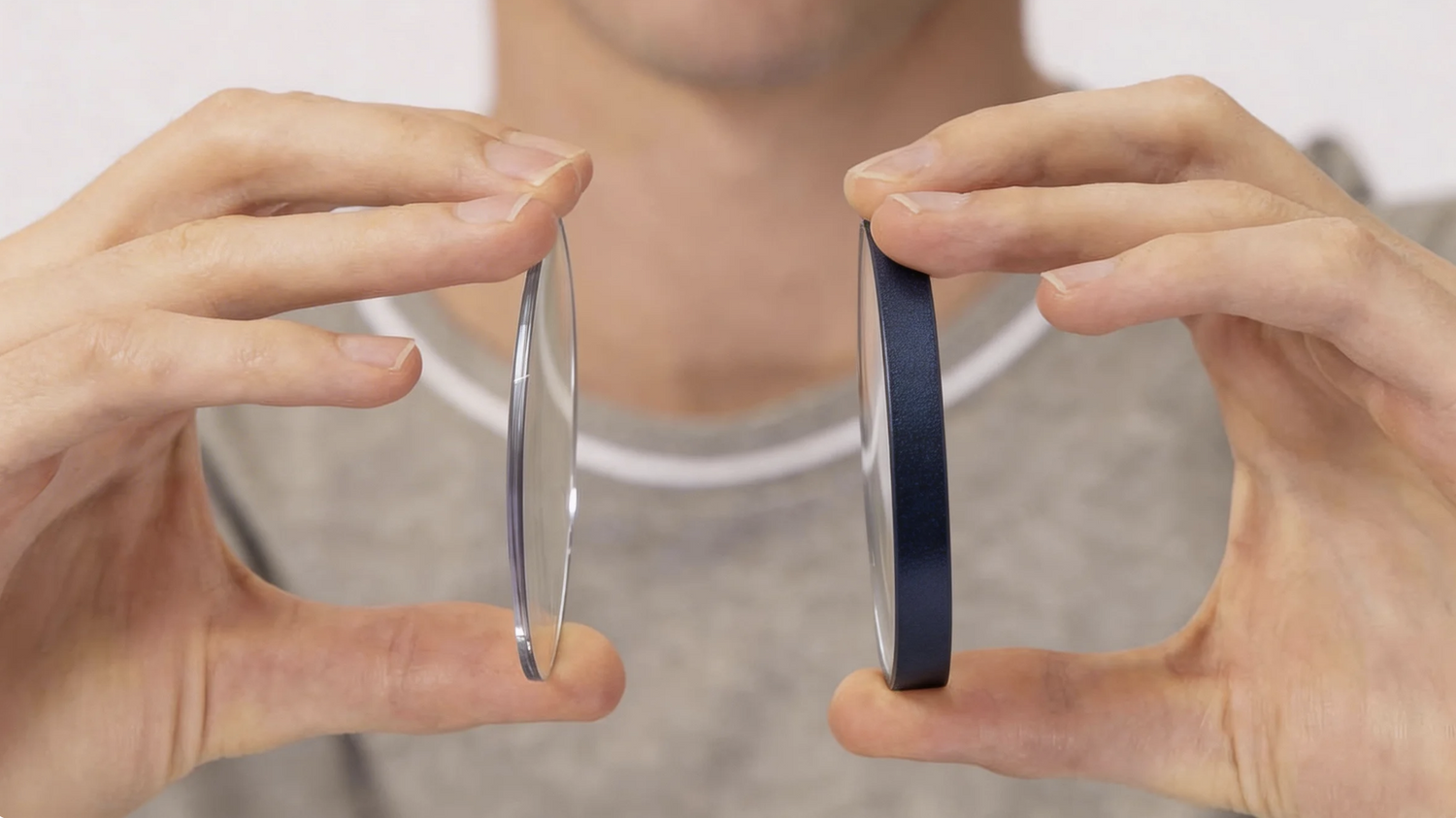
Finding the perfect pair of glasses is about more than just picking a stylish frame; it’s about the science behind the lenses. For many eyewear wearers, the most confusing part of the journey is understanding eyewear lens thickness. If you have a high prescription, you’ve likely worried about the "Coke-bottle" effect—where thick lenses protrude from the frame, adding unnecessary weight and distorting your facial features.
This complete high-index buying guide is designed to demystify the technical jargon. We will help you understand how to balance optical clarity with aesthetic appeal, ensuring your next pair of glasses is as light and sleek as possible. Let’s dive into the world of lens indices and find the perfect match for your vision needs.
1. What is Eyeglass Lens Index?
In the world of optics, the term "index" refers to the Refractive Index of the lens material. Simply put, it is a measurement of how efficiently a material bends (refracts) light. The higher the index, the more effective the material is at bending light rays.
Because high-index lenses are more efficient, they require less physical material to achieve a specific prescription power. This results in a lens that is significantly thinner and lighter than a standard alternative. When browsing for eyewear, you will typically see numbers ranging from 1.50 to 1.74.
| Lens Index | Description | Best For (Prescription) |
|---|---|---|
| 1.50 Index | Standard Plastic (Free/Basic) | Mild Rx (+/- 2.00 or lower). Economical but thicker. |
| 1.56 Index | Mid-Index (Slim) | Mild to moderate Rx (+/- 2.00). 15% thinner than 1.50. |
| 1.61 Index | High-Index (Thin) | Moderate Rx (+/- 2.00 to +/- 4.00). Great durability for rimless frames. |
| 1.67 Index | Super-Thin Index | Strong Rx (+/- 4.00 to +/- 6.00). Significantly reduces edge thickness. |
| 1.71 Index | Premium Ultra-Thin | Very Strong Rx (+/- 4.00 to +/- 8.00). Excellent optical clarity. |
| 1.74 Index | Ultra-Thin (Thinnest) | Highest Rx (+/- 8.00+). Maximum aesthetic and weight reduction. |
2. The Relationship Between Prescription and Thickness
To understand why lens thickness varies, we need to look at how lenses are shaped. A corrective lens works by curving the glass or plastic to redirect light onto your retina.
- Nearsightedness (Myopia): Lenses are thinner in the center and thicker at the edges. The higher the negative (-) power, the thicker the outer edges of the lens become.
- Farsightedness (Hyperopia): Lenses are thicker in the center and thinner at the edges. The higher the positive (+) power, the more the center of the lens bulges.
This is where the prescription strength plays a decisive role. If you have a high prescription but choose our free 1.50 index lens, the laboratory must use a substantial amount of material to achieve that curve, resulting in a heavy and bulky profile. By upgrading to high-index materials like 1.67 or 1.74, the lens can achieve the same corrective power with a much flatter curve, dramatically reducing the edge thickness and overall weight of your eyewear.

Pro Tip: While 1.50 is perfect for light prescriptions, moving up even one level to 1.56 can make a noticeable difference in weight for all-day comfort!
3. 1.50 to 1.74: Which Index is Right for Your Rx?
Choosing the right eyewear lens thickness is a balance between your prescription strength and your budget. Below is a detailed breakdown of the six major lens indices to help you identify the perfect match for your specific vision needs.
- 1.50 Index (Standard): Our basic, free option. It is best suited for those with a mild prescription between 0 and +/- 2.00 SPH. While optically clear, these lenses can become quite heavy and thick if used for higher prescriptions.
- 1.56 Index (Mid-Index): A great entry-level upgrade. This index is approximately 15% thinner than standard plastic and works well for prescriptions up to +/- 2.00 SPH.
- 1.61 Index (High-Index): This is the "sweet spot" for many. It is significantly thinner and stronger than 1.56, making it ideal for prescriptions ranging from +/- 2.00 to +/- 4.00 SPH. Its tensile strength also makes it the preferred choice for rimless or semi-rimless frames.
- 1.67 Index (Super-Thin): Designed for strong prescriptions between +/- 4.00 and +/- 6.00 SPH. At this level, you will notice a major reduction in the "bulge" of the lens, allowing for a much wider variety of frame choices.
- 1.71 Index (Premium Ultra-Thin): A sophisticated high-index material that offers a superior balance of thinness and optical clarity (Abbe value). It is highly recommended for very strong prescriptions between +/- 4.00 and +/- 8.00 SPH.
- 1.74 Index (Ultra-Thin): The thinnest and lightest plastic lens available on the market today. If your prescription is +/- 8.00 SPH or higher, this index is essential to achieve a sleek, aesthetically pleasing look and to minimize the magnification/minification of your eyes.
| Your SPH Prescription | Recommended Index |
|---|---|
| Planos to +/- 2.00 | 1.50 (Standard) |
| Planos to +/- 2.00 | 1.56 Mid-Index |
| +/- 2.00 to +/- 4.00 | 1.61 High-Index |
| +/- 4.00 to +/- 6.00 | 1.67 Super-Thin |
| +/- 4 to +/- 8.00 | 1.71 Premium Ultra-Thin |
| +/- 8.00 and Above | 1.74 Ultra-Thin |
4. Why High-Index Lenses Are a Game Changer for High Myopia
For those living with high myopia (severe nearsightedness), glasses have historically been a source of frustration. Standard lenses for high prescriptions often suffer from two major flaws: excessive edge thickness and heavy weight.
High-index lenses serve as a "game changer" by addressing these issues through advanced material science:
Benefits for High Prescriptions:
- Reduced Weight: By using less material, high-index lenses can be up to 50% lighter than standard 1.50 lenses. This prevents your glasses from sliding down your nose and eliminates painful pressure points.
- Eliminating the "Coke-Bottle" Look: High-index materials compress the lens profile, ensuring that the edges do not spill out over the side of the frame. This allows you to wear trendy, thin metal frames that were once impossible for high Rx wearers.
- Improved Visual Fidelity: Modern high-index options, especially 1.71 and 1.74 lenses, are designed to reduce peripheral distortions and the "minified" eye appearance, making your eyes look more natural behind the glasses.
Ultimately, choosing a thinner lens is about confidence. When you aren't worried about the weight of your frames or the thickness of your lenses, you can focus on what matters—seeing the world with absolute clarity.

5. Does Frame Size Impact How Thick Your Lenses Look?
Even the most advanced high-index lenses can look thick if paired with the wrong frame. In optics, the frame acts as the "canvas" for your prescription.
Understanding how frame geometry interacts with lens physics is the secret to a sleek, professional look.
Sub-point 1: Small vs. Large Frames: The "Edge Effect"
For nearsightedness (myopia), lenses are thinnest at the center and get progressively thicker toward the edges.
When you choose a large, oversized frame, the optical lab must preserve more of the lens's outer perimeter to fill the frame.
This is known as the "Edge Effect." By opting for a smaller lens diameter, you effectively "cut away" the thickest part of the lens, resulting in a significantly slimmer profile.
Sub-point 2: Why Round Frames are Better for High Prescriptions
Frame shape is just as vital as size. Rectangular or square frames have corners that are far from the optical center. These corners often become the thickest points of the eyewear.
Round or Boston-style frames, however, have a more consistent radius. This circular geometry allows for the most efficient lens cutting, leaving you with a balanced and thinner edge all the way around.
Sub-point 3: The Hidden Role of Your Pupillary Distance (PD)
Your Pupillary Distance (PD) is the distance between your pupils.
For the best aesthetics, your eyes should be centered within each lens. If you choose a frame that is much wider than your PD, the lab must "decenter" the lens to align the optical center with your pupil.
This shift causes one side of the lens to become disproportionately thick. A frame that matches your PD ensures the thickness is minimized and symmetrical.
Don't know how to measure your PD at home?
Read our professional guide here→
Sub-point 4: Using Frame Thickness to Conceal Lens Edges
The material of your frame can act as a clever disguise. While thin metal wires are trendy, they offer no "coverage" for the lens edge.
In contrast, PC or Acetate frames have thicker rims that can physically hide the edge of a high-index lens. Choosing a frame with a slightly thicker profile is a strategic way to mask lens depth for strong prescriptions.
✨ The High Rx Golden Rule
For the ultimate aesthetic result: Small, Round, and Centered. Combining these three frame elements with a high-index lens is the most effective way to eliminate the "Coke-bottle" look.
6. The Benefits of 1.74 Ultra-Thin Lenses
As the pinnacle of modern lens technology, 1.74 ultra-thin lenses are designed for those who refuse to compromise on style or comfort. If your prescription is over +/- 6.00, upgrading to 1.74 offers more than just visual clarity; it provides a transformative wearing experience.
- Maximum Weight Reduction: Up to 50% lighter than standard 1.50 lenses, reducing bridge pressure and ear fatigue.
- Flatter Lens Profile: Reduces the "magnification" or "minification" effect, keeping your eyes looking natural.
- Premium Optical Clarity: Engineered to minimize peripheral distortion and chromatic aberration.


7.Conclusion: Investing in Your Vision and Style
Choosing the right eyewear lens thickness is the final, crucial step in personalizing your glasses. As we’ve explored, the journey from a standard 1.50 index to a premium 1.74 ultra-thin lens is about finding the perfect equilibrium between your prescription strength, frame choice, and personal comfort.
Remember the High Rx Golden Rule: for the sleekest results, pair your high-index lenses with smaller, rounded frames that center your eyes. Whether you are managing mild myopia or navigating the challenges of a heavy prescription, modern optical technology ensures that you no longer have to sacrifice fashion for function.
Ready for a Clearer, Lighter View?
Don't let thick lenses hold back your personal style. Explore our collection of high-index ready frames and customize your perfect pair today. From digital-ready blue light protection to sunlight-adaptive photochromic lenses, your ideal vision solution is just a few clicks away.
Precision. Comfort. Velora Style.
Frequently Asked Questions
1. Is 1.74 high-index really worth the extra cost?
Absolutely, if you have a prescription above +/- 6.00. The 1.74 index is up to 50% thinner than standard lenses. Beyond just aesthetics, it significantly reduces the weight of your glasses, preventing them from sliding down your nose and causing discomfort during long days.
2. Does a higher index mean I will see more clearly?
Not necessarily. Clarity is often measured by the "Abbe Value." While high-index lenses are much thinner, some materials like 1.61 or 1.71 offer a fantastic balance of thinness and high optical clarity. However, for high prescriptions, the reduction in edge distortion with a 1.74 lens often leads to a better overall visual experience.
3. Can I use a 1.50 standard lens for a high prescription?
Technically, yes, but it is not recommended. For strong prescriptions, a 1.50 lens will be exceptionally thick and heavy, often protruding far beyond the edges of the frame. This creates a "magnifying glass" effect and can be quite uncomfortable for all-day wear.
4. Why did my 1.67 lenses still come out looking thick?
This usually happens due to frame choice. If you select a very large or wide frame, the lens edges will naturally be thicker. To maximize the thinning effect of your high-index lenses, always try to pick a frame that is proportional to your face and keeps your eyes centered.
5. Are high-index lenses compatible with blue light blocking or anti-fog coatings?
Yes! High-index materials (1.61, 1.67, 1.74) are fully compatible with all modern lens treatments. You can easily combine the thinness of a high-index lens with blue light filtering, photochromic (light-adjusting) tints, and anti-reflective coatings for the ultimate vision solution.


Leave a comment
This site is protected by hCaptcha and the hCaptcha Privacy Policy and Terms of Service apply.