
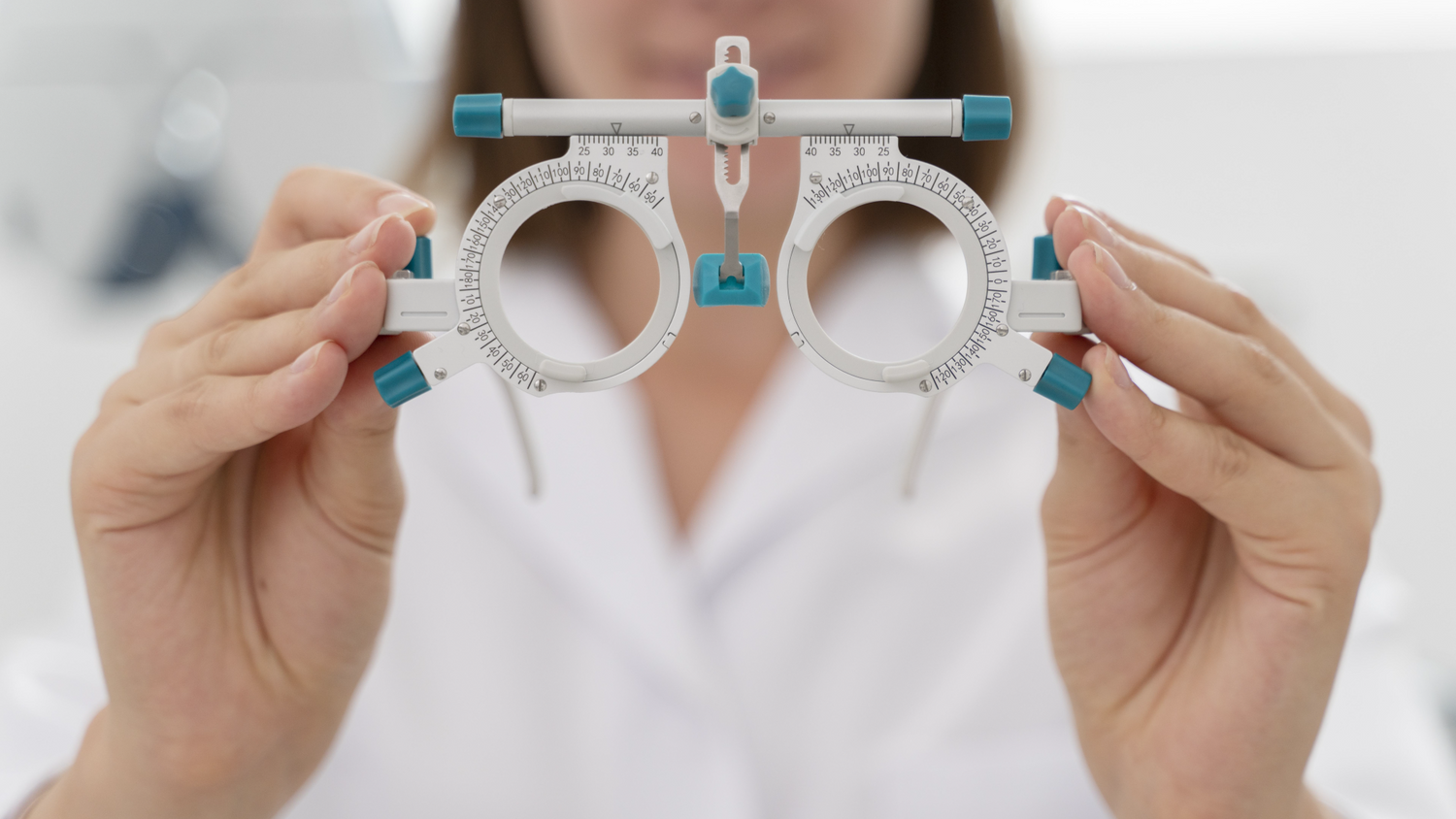
How to Measure Your PD at Home:A Quick 5-Minute Guide
You’ve picked the perfect frame to contour your face, and you have your prescription in hand. But then, you see a small, three-letter box asking for your PD.
If you’re wondering, "What is PD, and how do I find it?" you aren’t alone. While your eye doctor often measures this during an exam, it isn’t always written on your prescription. Measuring your pupillary distance at home is simple, fast, and surprisingly accurate when done correctly.
In this 5-minute guide, we will walk you through everything you need to know about pupillary distance, from the technical "why" to the step-by-step "how."
1. What is Pupillary Distance (PD)?
At its simplest, pupillary distance (PD) is the measurement of the distance between the centers of your two pupils, measured in millimeters (mm).
Think of your glasses as a high-precision optical instrument. Every lens has an "optical center"—the specific point on the glass where the vision is clearest and the correction is most accurate.
To provide you with the "Gold Standard" of vision, our master opticians must align the optical center of your lenses directly in front of your pupils.
When you measure pupillary distance, you are essentially providing us with a map of your face. This ensures that when you put on your glasses, your eyes are looking through the exact "sweet spot" of the lens, rather than off-center.

2. Why is PD So Important?
You might be thinking, "Can a few millimeters really make a difference?" The short answer is: Absolutely.
If your PD measurement is incorrect, the optical centers of your lenses will not align with your pupils. This creates what opticians call "Induced Prism." When this happens, your brain has to work overtime to compensate for the displaced image, leading to several uncomfortable symptoms:
- Eye Strain & Fatigue: Your eye muscles will constantly strain to find the focus point.
- Headaches: Prolonged use of glasses with an incorrect PD is a leading cause of "mystery" headaches.
- Blurred Vision: You won't be getting the full benefit of your prescription.
- Nausea or Dizziness: Especially in higher prescriptions or progressive lenses, a wrong PD can make the world feel like it's tilting.
3. What is Single and Dual PD?
When you go to enter your details on our site, you might notice two options: Single PD and Dual PD. Understanding the difference is key to your order's precision.
Single PD (Binocular PD)
This is the total distance from the center of one pupil to the center of the other. For most adults, this is a single number ranging between 54mm and 74mm.
Dual PD (Monocular PD)
No one's face is perfectly symmetrical. Dual PD consists of two numbers—the distance from the center of each pupil to the bridge of your nose. It is written as two numbers (e.g., 32/31.5).

- Velora's Advantage: Unlike many budget retailers, Velora provides a dual PD prescription option in our ordering system. We believe that for those with asymmetrical features, Dual PD offers a superior, more comfortable optical fit.
4. How to Measure Pupillary Distance at Home
You don't need a degree in optometry to get a great measurement. You just need a bit of patience and a few household items. Here are the three most effective ways to measure PD at home.
Method A: The Mirror & Ruler Method (Best for Solos)
This is the most popular method for those ordering their glasses independently.
- Find a Mirror: Stand in a well-lit room in front of a mirror (about 8–12 inches away).
- Or download our PDF ruler→
- Hold the Ruler: Hold a millimeter ruler flat against your brow line.
- Align the Zero: Close your right eye and align the 0mm mark of the ruler directly with the center of your left pupil.
- The Measurement: Keep the ruler steady. Open your right eye and close your left eye. Look straight ahead and find the millimeter mark that aligns with the center of your right pupil.
- Record and Repeat: Note the number. We strongly recommend repeating this 3 times to ensure consistency.

Method B: The Credit Card Method (The "No Ruler" Hack)
Did you know a standard credit card is a global measurement tool? The width of a standard card is exactly 85.6mm.
- Position the Card: Stand in front of a mirror or your phone camera. Hold the credit card against your forehead, just above your eyebrows, with the long edge touching your brow.
- Take a Photo: Take a straight-on selfie. Ensure you aren't tilting your head.
- Reference the Scale: By using the known width of the card, the distance between your pupils can be calculated.
- Measure the pixels: Measure the “width of the credit card” in the photo on the screen in pixels with your computer or phone (e.g., P1, 430px in the picture below), then measure the “distance from the center of the left pupil to the center of the right pupil” in the photo on the screen in pixels (e.g., P2, 272px in the picture below).
- Calculate: Your PD=(P2/P1)*85.6mm. In the picture below, the PD of this lady is about 54mm.
Note: While handy, using a millimeter ruler is generally more accurate for high-prescription orders.

Method C: The "Best Friend" Method (Highest Accuracy)
- Face Your Partner: Sit across from a friend (about arm’s length away).
- Focus: Look past your friend at an object in the distance (about 10–20 feet away). This ensures your eyes don't cross to look at the ruler.
- The Measurement: Your friend will hold the ruler against your forehead and measure from the center of your left pupil to the center of your right pupil.
5. What is the Average Interpupillary Distance?
If you've measured yourself and want to know if you're in the "normal" range, here is a quick reference table. If your number is significantly outside these ranges, try measuring one more time!
| Category | Average PD Range |
|---|---|
| Adult Males | 60mm to 73mm |
| Adult Females | 54mm to 68mm |
| Children | 43mm to 58mm |
6. Can I Get My PD From My Old Glasses?
This is a common question. If you have a pair of glasses that feels perfect, can you "extract" the PD from them?
Technically, yes, but it requires a specialized tool called a Lensometer. If you try to do this at home with a ruler, you are likely to measure the "frame PD" rather than the "lens PD," which can lead to errors.
If your old glasses feel comfortable, it is much safer to simply measure your pupillary distance at home using the mirror method than to guess where the optical center of your old lenses is.
7. Conclusion: Your Adventure, Clearly Defined
At Velora, we believe that every detail matters—from the hand-polishing of your frames to the millimeter-perfect placement of your lenses. Taking 5 minutes to measure your PD at home is the final step in ensuring your custom eyewear is as unique as your own perspective.
Now that you’ve mastered the art of PD measurement, you’re ready to complete your order with confidence. Whether you’ve opted for a Single PD or utilized our Dual PD options, our master opticians are ready to begin the rigorous process of crafting your vision.
Frequently Asked Questions
Q1: Will a 1-2mm error affect my vision?
For most single-vision prescriptions, a tiny 1-2mm difference is usually unnoticeable. However, precision is vital for high prescriptions or progressive lenses. We recommend measuring three times and taking the average; our Velora™ team also reviews all data for potential errors.
Q2: My RX shows "Distance" and "Near" PD. Which do I use?
Use Distance PD for everyday glasses or driving. Use Near PD specifically for reading glasses. If you are unsure, simply upload your prescription photo and our opticians will handle the rest.
Q3: Does my PD change with different frame styles?
No. Your PD is a physical measurement of your face, similar to your height. It remains constant whether you choose oversized aviators or sleek, narrow frames.
Q4: Are PD-measuring Apps accurate?
Apps are convenient but depend on camera calibration. For the "Velora Gold Standard" of accuracy, we suggest cross-referencing any App result with our manual Mirror & Ruler method.
Q5: Why isn't my PD on my prescription?
PD is often considered a "fitting measurement" rather than a medical diagnosis, so doctors frequently omit it. It’s not an error—simply follow our guide to get your measurement and start your style adventure.

Leave a comment
This site is protected by hCaptcha and the hCaptcha Privacy Policy and Terms of Service apply.