
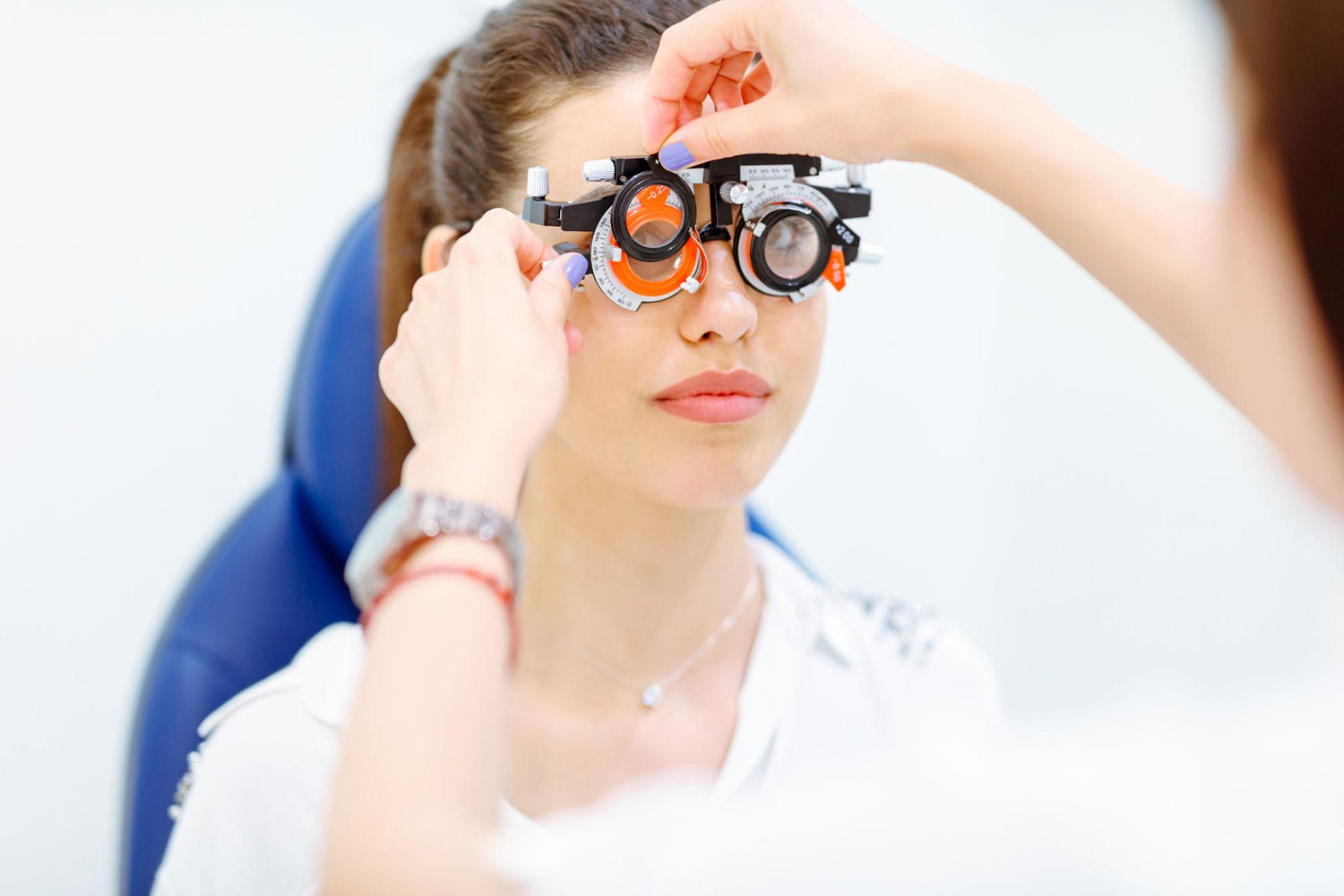
Precise Data Collection in Prescription Eyeglass Refraction
Accurate prescription eyewear begins with high-precision data collection during the eye examination process. Modern optometry combines clinical techniques and digital measurement systems to capture detailed visual information, ensuring lens prescriptions are tailored to individual visual behavior rather than basic eyesight estimation.

Objective Measurement Techniques in Vision Testing
Automated refraction scanning systems
Objective refraction begins with automated devices that analyze how light changes direction as it passes through the eye. These systems generate an initial baseline for spherical and cylindrical values without requiring subjective responses from the patient. This step improves efficiency and reduces early estimation errors.
Wavefront analysis for optical mapping
Wavefront technology captures how light waves distort as they travel through the eye’s optical system. This creates a detailed visual map of irregularities, including higher-order aberrations that traditional methods may miss. The result is a deeper understanding of visual clarity issues beyond standard refractive errors.
Corneal curvature measurement
Keratometry is used to measure the curvature of the cornea. This data is essential for identifying astigmatism patterns and ensuring that corrective lenses align properly with the eye’s natural shape. Even minor curvature variations can significantly influence visual sharpness.
Subjective Refraction and Visual Fine-Tuning

Lens comparison testing
After objective measurements, subjective refraction refines the prescription through patient feedback. Different lens combinations are presented, and the patient indicates which provides clearer and more comfortable vision. This step ensures that the final prescription aligns with real-world visual perception.
Binocular balance optimization
Both eyes are evaluated together to ensure they function harmoniously. Small adjustments are made to balance clarity between the left and right eye, improving depth perception and reducing visual fatigue during extended use.
Near and distance focus calibration
Testing is performed at multiple viewing distances to ensure clarity across daily tasks such as reading, screen use, and outdoor viewing. This helps create a balanced prescription that supports both close-up and long-range vision.

Digital Imaging and Advanced Measurement Integration
Pupillary distance and alignment capture
Precise measurement of pupillary distance ensures that lenses are centered correctly in front of each eye. Modern systems often use digital imaging to capture facial geometry, improving alignment accuracy for long-term comfort.
Eye tracking and focus behavior analysis
Some advanced systems monitor how the eyes move and focus during reading or visual tasks. This helps identify inconsistencies in eye coordination and supports more personalized lens optimization.
Tear film and ocular surface evaluation
The stability of the tear film affects how light enters the eye. Measuring ocular surface quality helps ensure that prescriptions remain effective under real-world conditions such as screen exposure or dry environments.
Integration of Multi-Source Data for Final Prescription Accuracy
Data cross-validation process
All collected data—objective, subjective, and digital—is compared to ensure consistency. If discrepancies appear between measurement systems, additional refinement testing is performed to reach a stable and reliable prescription outcome.
Personalized lens parameter adjustment
Final lens parameters are adjusted based on lifestyle needs, visual habits, and measured ocular behavior. This ensures that the prescription is not only clinically accurate but also functionally comfortable in everyday use.
Modern Eyewear Experience and Design Considerations
Precise optical data collection is only one part of the modern eyewear experience. Once visual parameters are defined, attention often shifts toward comfort, aesthetics, and long-term wearability. High-quality eyewear today combines scientific accuracy with refined design principles to support both vision correction and personal expression.
Discover Velora Official, where elegance meets precision. Est. 2023, we specialize in luxury custom prescription glasses and high-end sunglasses designed to empower your style. From iconic cat-eye frames to sophisticated modern designs, our eyewear is crafted with premium materials for lasting comfort. Official website address: https://velora-glasses.com/



Leave a comment
This site is protected by hCaptcha and the hCaptcha Privacy Policy and Terms of Service apply.