

Picture this: You’re driving home at night, and the streetlights look like explosive starbursts. Or maybe you're sitting at a restaurant, subtly moving the menu further away just to decipher the appetizers. You catch yourself doing it and think, "Wait... do I need prescription glasses?"
If you are googling "how to know if I need glasses," you are already half a step into the answer. But as eyewear industry veterans here at Velora, we’re going to tell you an optical secret that might surprise you: Not everyone who experiences blurry vision actually needs glasses.
Most medical websites will immediately tell you to "book a doctor's appointment." While an eye exam is never a bad idea, we know that finding the time, worrying about the cost, or just the anxiety of a medical visit can make you hesitate.
This guide is different. Based on optical science and our experience fitting thousands of first-time wearers, we are going to help you triage your symptoms at home. We will walk through the undeniable signs you need glasses, explain exactly why your eyes are acting up, and help you determine if you just need a good night's sleep or a real prescription. Let's figure this out together.
1. The 5 Major Signs You Need Glasses (And the Science Behind Them)
Vision changes usually don't happen overnight. They creep up on you. In our 2025 Velora First-Time Wearer Study (which surveyed over 10,000 customers), we found a fascinating piece of data: 68% of people waited over 14 months to get their first pair of glasses after noticing their first symptom. Why? Because they convinced themselves it was just "normal fatigue."
Here are the five classic indicators that it’s time to stop guessing and get your eyes checked.
Sign #1: The Classic "Squint"
Do you find yourself narrowing your eyes to read street signs or the TV guide? You aren't doing this to look intensely focused. Squinting is your body's clever biological hack.
Why it happens: When you squint, you change the shape of your eye very slightly and reduce the amount of light entering your pupil. This creates a "pinhole camera" effect, temporarily sharpening the image on your retina. If you have to squint to see clearly, it is a glaring sign of a refractive error like myopia (nearsightedness) or astigmatism.
Sign #2: Frontal Headaches After Deep Work
Not all headaches are related to vision, but the location and timing of the headache are dead giveaways. According to the American Optometric Association (AOA), vision-induced headaches typically occur at the front of the head (right behind the eyebrows) or at the temples, usually manifesting mid-afternoon or after a long session at the computer.
Why it happens: Inside your eye is a tiny muscle called the ciliary muscle. When your cornea or lens isn't focusing light properly (especially in cases of hyperopia/farsightedness or astigmatism), this muscle works overtime, constantly flexing to force the eye into focus. Just like doing bicep curls for 8 hours straight, that muscle fatigues, radiating pain to your forehead.
Sign #3: Halos and Starbursts at Night
If driving at night feels like you are looking through a dirty windshield, or oncoming headlights look like exploding fireworks, you shouldn't ignore it.
Why it happens: This is a classic symptom of astigmatism. A normal eye is perfectly round like a basketball. An eye with astigmatism is shaped more like a football. This irregular curve scatters light as it enters the eye instead of focusing it cleanly on a single point, causing light sources to bloom or stretch in the dark.
Sign #4: The "Trombone Arm" Effect
You are reading a label on a medicine bottle, and you instinctively push it further away from your face to make it clear. We affectionately call this the "Trombone Arm."
Why it happens: If you are over the age of 40, this is almost certainly Presbyopia. As we age, the crystalline lens inside our eye loses its elasticity. It becomes harder, making it difficult to "zoom in" on close objects. This is a completely natural part of aging, and yes, reading glasses (or progressive lenses) are the definitive fix.

📊 Velora Insider Insight: The "Denial Phase"
Our customer data shows that the "Trombone Arm" (Presbyopia) has the longest denial phase. Customers aged 42-48 often increase their phone font size up to 3 times before finally admitting they need glasses. If you are reading this on max font size, consider this your friendly wake-up call!
2. How Serious Are These Signs? (The At-Home Triage Guide)
Let’s be real. It’s 2026. We stare at screens all day, and occasionally, our eyes are just exhausted. So, how do you differentiate between "I stared at a spreadsheet for 10 hours" and "Should I get glasses?"
Before you panic and book an eye exam, we recommend doing a 48-hour self-assessment. Not all blurry vision is a refractive error. Sometimes, it’s temporary environmental stress.
The "Weekend Reset" Test
Try this: For one entire weekend, cut your screen time by 70%. Drink plenty of water and apply lubricating eye drops (not redness-relief drops, just pure artificial tears) twice a day. Use the 20-20-20 rule (every 20 minutes, look at something 20 feet away for 20 seconds).
The Result: If your headaches disappear and your vision sharpens on Monday morning, you might not need a prescription—you likely just have Digital Eye Strain. If the blurriness and squinting persist despite resting your eyes, it’s time for a professional check.
Visual Triage: Fatigue vs. Prescription Need
Use this simple comparison matrix we use to guide our clients:
| Symptom | Likely Just Fatigue (Rest Needed) | Likely Refractive Error (Glasses Needed) |
|---|---|---|
| Blurry Vision | Fluctuates throughout the day. Worse at 5 PM, fine in the morning. | Consistent. Blurry immediately upon waking up and looking at the alarm clock. |
| Headaches | Feels like pressure behind the eyes; goes away after sleeping. | Located at the temples/forehead; happens when doing specific tasks (driving, reading). |
| Night Vision | A little dry or sensitive to bright screens in a dark room. | Severe halos around headlights; feeling unsafe driving at night. |
| Eye Rubbing | Eyes feel "scratchy" or dry (common in air-conditioned offices). | Rubbing eyes constantly to "clear away" the blur, but it doesn't work. |
*Disclaimer: We are optical experts, not medical doctors. If you experience sudden, severe vision loss, flashing lights, or a curtain-like shadow over your vision, skip this guide and visit an emergency room immediately.
3. The Limits of Self-Diagnosis (And Why Eye Exams Aren't Scary)
So, you’ve failed the "Weekend Reset" test. You’re squinting, your head hurts, and you’re pretty sure you need glasses. At this point, you might be tempted to download one of those "free vision test" apps or grab a cheap pair of magnifying readers from the pharmacy.
Please don’t do that.
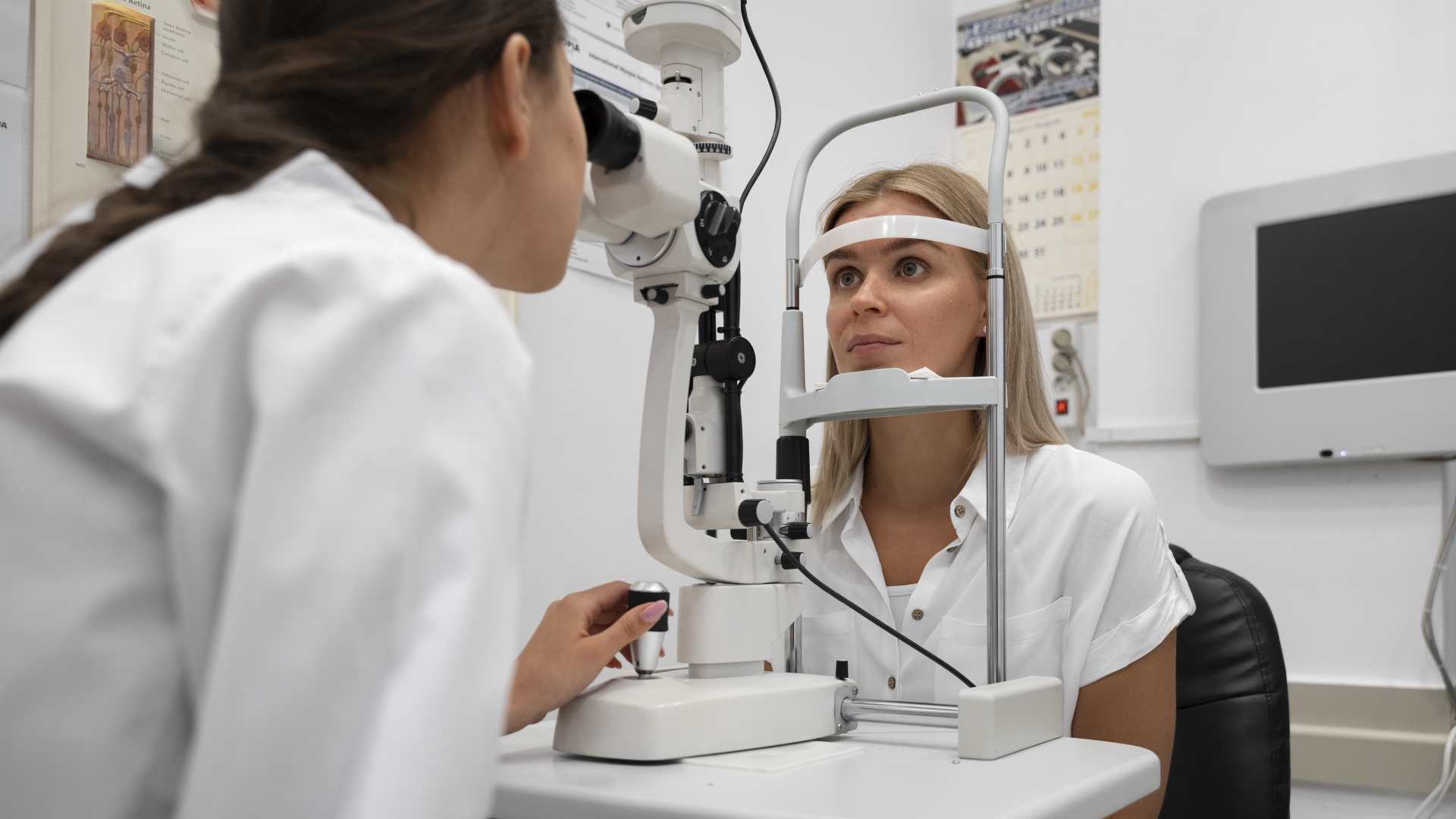
While our triage guide is a great starting point, an eye exam does something no app can do: it looks inside your eye. Optometrists don't just check if you can read letters on a wall; they look at the blood vessels in your retina. A routine eye exam can detect early signs of diabetes, high blood pressure, and glaucoma long before you feel any symptoms.
📊 Velora Lab Insight: The "Asymmetry" Factor
Why are drugstore glasses risky? Based on the prescription data processed in the Velora Optical Lab in early 2026, a staggering 82% of our customers have a different prescription in their left eye compared to their right eye. Furthermore, 65% require some degree of astigmatism correction. Over-the-counter reading glasses use the exact same magnification for both eyes. Wearing them when you have asymmetrical vision is like wearing a size 9 shoe on your left foot and a size 10 on your right—it will ultimately cause more pain.
The Velora "Smart Shopper" Hack
We know the real reason people avoid the eye doctor: The hard sell. Nobody wants to pay for an exam and then be pressured into buying a $400 pair of frames in the waiting room.
Here is the industry secret: By law (in the US via the FTC's Prescription Release Rule), your eye doctor must give you a copy of your prescription immediately after the exam, at no extra cost.
4. Common Myths & When You Actually DON'T Need Glasses
Over the years, we've heard every excuse in the book for why people delay getting glasses. Let’s clear the air by busting the biggest myths—and honestly addressing the situations where glasses aren't the answer at all.
Myth #1: "If I start wearing glasses, my eyes will get lazy and my vision will get worse."
The Truth: This is the #1 most common optical myth. Glasses do not change the physical shape of your eye, nor do they "weaken" your eye muscles. When you wear the correct prescription, your eyes finally get to relax. If your vision feels worse when you take them off, it’s simply because your brain has grown accustomed to seeing the world in high-definition, and it suddenly realizes how blurry your "normal" vision actually is.
Myth #2: "I only struggle a little bit at night; it's not worth the investment."
The Truth: Micro-strains add up. Even a very mild prescription (like a -0.50) can drastically reduce nighttime glare and visual fatigue. Plus, with direct-to-consumer brands like Velora, fixing that "little bit of struggle" doesn't require a massive financial investment anymore.

Wait... When do I NOT need glasses?
As an eyewear brand, you’d expect us to tell everyone to buy a pair. But we believe in transparency. You probably do not need prescription glasses if:
- Your only symptom is dry, red eyes. If your vision is perfectly sharp but your eyes burn, you likely have Dry Eye Syndrome. Limit your AC exposure, use warm compresses, and get good lubricating drops. Glasses won't fix a tear-film issue.
- Your blurriness is tied to a specific medication. Certain antihistamines, antidepressants, and blood pressure medications can temporarily alter your vision or cause severe dryness. Consult your physician first.
- You just had an eye exam 3 months ago. Adult vision rarely changes drastically in just a few months. If you suddenly experience severe blurriness right after a clean bill of health, see a doctor immediately—this could be a medical emergency, not a need for new lenses.
5. The Age Factor: How Your Eyes' Needs Shift Over Time
One of the biggest mistakes people make when Googling their vision symptoms is ignoring their age. A 24-year-old software engineer and a 52-year-old project manager might both complain about "blurry text," but the underlying mechanics—and the solutions—are entirely different.

Vision is not static. Here is a breakdown of what is likely happening to your eyes right now, based on your current stage of life:
Your 20s to 30s: The Screen Strain Era
In this demographic, true vision degradation is less common unless you've had myopia (nearsightedness) since childhood. If you are suddenly experiencing blurriness in your late 20s, it is usually Accommodative Spasm (your eye muscles cramping from staring at close objects like phones) or the emergence of mild Astigmatism exacerbated by screen glare. You might just need a very light prescription combined with premium blue-light-blocking tech to relax your eyes during the workday.
Your 40s: The Great Transition
Welcome to the "Trombone Arm" phase we mentioned earlier. Right around age 42 to 45, the natural lens inside your eye starts losing its flexibility. Even if you've had 20/20 vision your entire life, you will likely start struggling with restaurant menus or reading texts in low light. This is Presbyopia. It happens to literally everyone, and single-vision reading glasses are your new best friend.
Your 50s and Beyond: The Need for Seamlessness
At this stage, you likely need help seeing both far away (driving) and up close (reading). Constantly taking reading glasses on and off becomes incredibly frustrating. This is where Progressive Lenses (no-line bifocals) become essential, allowing you to seamlessly transition your focus across all distances within a single pair of frames.
📊 Velora 2026 Internal Demographics Report
When we analyzed our customer purchasing habits this year, we discovered a rising trend we call "Micro-Prescriptions." Over 40% of our customers in their late 20s and early 30s are ordering glasses with very minor corrections (like -0.25 sphere or -0.50 cylinder). They don't medically need them to function, but they buy them specifically as "productivity tools" to eliminate the micro-squinting that causes 4 PM brain fog.
6. Try These 3 Things Before Buying Glasses (Yes, Really)
We are an eyewear brand. Our business is selling glasses. But we are going to be completely honest with you: we don't want you to buy a pair of Velora glasses if you don't actually need them.
Before you spend a dime on an eye exam or new frames, try implementing these three "Visual Hygiene" habits for exactly 5 days. If your symptoms go away, congratulations—your eyes are fine, you were just treating them poorly.
-
📏The "High-Five" Distance Rule Your computer monitor should be roughly an arm's length away from your face. Sit back, reach your arm straight out, and try to high-five your screen. If your knuckles hit the monitor while your elbow is bent, you are sitting way too close. Push it back.
-
💧The Humidifier Hack When we stare at screens or AI tools, our blink rate drops by up to 60%. If you work in an air-conditioned room or during winter when the heater is blasting, your tears evaporate instantly, causing blurry vision. Put a small desktop humidifier next to your keyboard.
-
💡Eliminate the "Cave Glow" Working in a dark room with only the bright glow of your monitor forces your pupils to constantly expand and contract, causing severe fatigue. Turn on a soft ambient desk lamp behind your monitor (known as bias lighting) to balance the contrast.
Still Squinting? Let's Make This Easy.
If you've optimized your workspace, given your eyes a rest, and you still can't read the street signs clearly at night—it’s time to face the facts. You need prescription glasses.
The good news? Getting them in 2026 doesn't mean spending an entire Saturday at a sterile optical shop and dropping $300 on frames.
Once you have your prescription, Velora makes the rest effortless. We cut out the traditional retail markups so you can get premium, custom-crafted frames starting at incredibly affordable prices. And because we know buying online can feel risky for a first-timer, we remove the risk entirely.
We stand by our optical lab. If your prescription feels off, if the frames don't sit right on your nose, or if there's any manufacturing defect within 365 days, we will fix it or replace it. No endless customer service loops, no hidden fees. Just clear vision, guaranteed.
7. Start Your Clear Vision Journey with Velora
Admitting you need glasses is the hard part. Finding a pair that makes you look incredible and doesn't empty your wallet? That’s where we come in.
Whether you are looking for an ultra-light frame to survive 10-hour coding sessions, or a trendy geometric style that transitions smoothly from the office to the outdoors, we’ve custom-crafted something for you. Choose your perfect frame below and start seeing the world the way it was meant to be seen. ↓

VELOPT-105 Boston
Minimalist Boston style designed for all-day comfort. So light you'll forget you're wearing them. Available in Onyx Black, Champagne, and Frost White.

VELOPT-545 Wayfarer
A trendy take on the classic wayfarer. Fully customizable with Blue Light, Photochromic, or Anti-Fog tech. Perfect for single vision or progressives.

VELOPT-603 Polygonal
Stand out from the crowd with striking polygonal lines. Engineered to support ultra-thin 1.74 lenses for high prescriptions without the bulk.
8. Frequently Asked Questions (FAQ)
Q: Can I wear blue light glasses if I don't have a prescription?
Absolutely. These are called "Plano" lenses. They offer the same HEV protection and anti-reflective benefits without any magnification. Many Velora customers use them purely as a "digital shield" to prevent AI-driven eye strain.
Q: Will wearing glasses make my eyes "weaker" or dependent on them?
No. This is a common myth. Glasses simply correct the way light hits your retina. They don't change the physical anatomy of your eye. Your eyes may feel "worse" when you take them off only because your brain now knows how clear the world should look.
Q: How often should I get my eyes checked if I don't currently wear glasses?
For adults under 40 with no symptoms, once every two years is recommended. However, if you are an "AI Power User" or spend over 8 hours a day on screens, an annual check-up is safer to monitor digital-induced changes.
Q: Can eye exercises replace the need for prescription glasses?
While "eye yoga" can help relax fatigued muscles (Ciliary muscles), it cannot fix refractive errors like an elongated eyeball (Myopia) or an irregularly shaped cornea (Astigmatism). Exercises are for comfort; lenses are for clarity.
Q: Why does my vision feel blurry even after I just got new glasses?
Your brain needs an "adaptation period," which usually lasts 3 to 7 days. During this time, your neural pathways are re-learning how to process sharp images. If the blur persists after a week, consult our Velora 1-year warranty team for a prescription re-check.

Julian V. Sterling
Julian is a senior eyewear consultant and lead optical designer at Velora. With over 12 years of experience in lens technology and retail operations, he has helped fit over 25,000 unique prescriptions, focusing on making high-end optical clarity accessible.

Leave a comment
This site is protected by hCaptcha and the hCaptcha Privacy Policy and Terms of Service apply.